Peer-reviewed articles have all been through a peer-review process. We practice double-blind peer-review. All material is reviewed by two independent specialists at least at post-doc level. A prerequisite for publishing scientific articles in Baltic Worlds is that the article has not already been published in English elsewhere. If an article is simultaneously being considered by another publication, this should be indicated when submitting.
This article examines the transformation of civic engagement in Russia after the start of the full-scale invasion of Ukraine in 2022. Drawing on more than a hundred interviews with civic and political activists across several Russian regions, the article traces how anti-war and oppositional initiatives transformed under conditions of escalating repression. Using a micro-sociological approach, the article foregrounds emotions and strategic dilemmas as key (dis)enables of civic engagement alongside with the political opportunity structures. It argues that Russian civil society has not collapsed, but has moved through several stages of the initial moral shock and immediate mobilization, towards fragmentation and cautious re-mobilization. By 2026 civic engagement persists primarily through informal and low-visibility forms, using strategic depolitization as a tactic to survive.
By
Ekaterina Kalinina
May 29, 2026
abstract This article examines the transformation of Russian civil society since the start of the full-scale invasion of Ukraine in […]
By
Irina Meyer Olimpieva
May 29, 2026
This article introduces the concept of media realism to theorize the political sensibility that emerges from feminists’ engagement with digital media in contemporary Russia and beyond. Drawing on empirical data and insights from the FEMCORUS research project, the article explores how activists and media professionals navigate the contradictory affordances of digital media ecosystems that simultaneously enable oppositional political expression and practices and impose significant structural constraints. In this context, media realism refers to the experience of digital media as flawed, yet without alternatives. Thus, the concept captures the affective and ethical (dis)orientation of activists who recognize the problematic underpinnings of existing ICTs (Information and Communication Technologies) architectures yet continue to rely on them for visibility, mobilization, and resistance. Through empirical case studies, the article demonstrates how feminist actors adapt their tactical repertoires and renegotiate their ethics due to a media environment shaped by both authoritarian repression and neoliberal media logic. Ultimately, media realism offers a grounded, non-reductionist framework for understanding the ambivalences of digital activism under constraints and invites further inquiry into how political subjectivities are shaped by the ICTs infrastructures they inhabit.
By
Daniil Zhaivoronok
May 29, 2026
Since the onset of Russia’s full-scale invasion of Ukraine, various ethnic protest and anti-war movements from Russia’s national republics have called for decolonization. While the focus of these initiatives lies in regional politics and ethnic and Indigenous rights, the movements also address women’s and LGBTQ rights. Based on content analysis of seven ethnic anti-war initiatives, this article examines the themes and frameworks through which questions related to gender and sexuality are addressed within the activist agendas of these initiatives. The analysis shows that while these questions play only a minor role in the ethnic anti-war activism, they are used to articulate systemic oppression and the harmful impact of Russian state policies on people in the national republics. Taken together, the ways in which gender and sexuality are discussed bring out the activists’ search for a discursive position between Russian and Western political and discursive regimes.
By
Eeva Kuikka
May 29, 2026
This paper aims to analyze how health professionals in Russia perceive their profession as a political issue and how the war has shaped this perception. The study focuses on healthcare providers whose narratives express explicit dissatisfaction with the Russian healthcare system, sustained criticism of it, and efforts to bring about change. Drawing on the strategic action field approach, we define these actors as challengers – that is, professionals who seek to alter the organizational field of healthcare and broader societal power relations. Medical professionals are generally considered as a politically neutral group and typically do not identify them selves as challengers of the social system. However, we reveal that at critical moments of war and migration, they explicitly connect their professional positions with issues of political power and political engagement. The paper draws on in-depth interviews with healthcare providers who left Russia shortly after February 2022. The analysis suggests that in the context of an authoritarian state, healthcare professionals challenge not only the organizational field but also the political order itself, thereby relinquishing claims to political neutrality in pursuit of systemic change.
By
Varvara Adrianova, Ivan Ivanov, and Miroslava Borisova
May 29, 2026
This article analyses how environmental activism in Russia has been reshaped under wartime authoritarianism following the full-scale invasion of Ukraine in 2022. Drawing on 34 semi-structured interviews with representatives of environmental organizations and initiatives conducted between 2022 and 2025, it examines how repression, co-optation, and nationalist politicization have transformed the field of environmental engagement. The article argues that the Russian state has reorganized the environmental field through the expansion of government-organized non-governmental organizations (GONGOs) and the promotion of sovereignty-centered narratives such as sovereign ecology” and green patriotism. While repression remains the main driver of depoliticization, GONGOs redefine the boundaries of legitimate environmental engagement by embedding ecological discourse within narratives of national sovereignty. Independent NGOs and grassroots initiatives have responded differently. These dynamics reveal how wartime authoritarianism restructures environmental activism.
By
Doriana Althier, Maria Tysiachniouk and Juha Kotilainen
May 29, 2026
Based on a holistic case study of a climate movement in Russia that emerged several years before and dissolved shortly after Russia’s full-scale invasion of Ukraine, this article explores the war’s impact on civil society activism. Drawing on in-depth interviews with key participants conducted both before and after the war, the study identifies three typical activist career paths which shape engagement with and disengagement from the movement.
The analysis of these career paths shows that the war did not introduce entirely new conditions but rather intensified problems the movement had already been struggling with. Moreover, it further raised the risks of protest participation and shifted activists’ attention from climate change to more urgent wartime concerns. The article contributes to understanding the Russo- Ukrainian war’s effect on Russian civil society. It also contributes to the literature on disengagement and demobilization in social movements by promoting a career approach and addressing the broader question of how a large-scale political event can lead to the demobilization of a social movement.
By
Svetlana Erpyleva
May 29, 2026
This article delves into the folk music community of Latvia and its reaction to Russia’s full-scale invasion of Ukraine in 2022. Rooted in the 20th-century folklore revival movement, during which Latvians revitalized their cultural heritage as a form of opposition to Soviet ideology, the community of Latvian folklore ensembles, musicians and enthusiasts has joined the broader civic initiative of giving aid to Ukraine and expressing solidarity with the Ukrainian people. Since February 2022, at least 80 initiatives linked to folklore (concerts, dance events, protests etc.) have been carried out that are directly connected to gathering support for or expressing solidarity with Ukraine. The analysis of these events reveals how the folklore community engages with political issues, using folklore as a medium to express its views in the contemporary political context.
By
Ilga Vālodze Abelkina
April 23, 2026
Drawing on five narrative interviews with women from Ukraine’s Donbas, this article explores how belonging and national identification shift across three temporalities: everyday life before 2014, the outbreak of war in 2014, and the full-scale invasion in 2022. Using grounded theory coding, it traces how conflicting Ukrainian and Russian nation-making projects are experienced through domestic routines, media consumption, and encounters with state institutions. Before 2014, regional pride and Russophone familiarity distanced Ukrainian narratives, until war shattered this normality and forced difficult, morally charged choices. After 2022, respondents describe intensified fear, betrayal, and a reconfiguration of home and belonging, while distinguishing survival from political loyalty under occupation. The article argues that identity in Donbas is neither binary nor linear, but a gendered, emotional, and relational process shaped through everyday practices and retrospective moral evaluation. By centring women’s voices, the study complicates top-down accounts of nationhood and shows why reconciliation must address mistrust, recognition, and personal repair and dignity.
By
Eva Ievgeniia Babenko
April 23, 2026
This article examines how female politicians in Poland’s contemporary Left navigate the complex legacies of socialism and communism in shaping their political identities and practices. Drawing on ethnographic fieldwork conducted before the 2019 parliamentary elections and during the 2021 party unification convention, as well as 23 in-depth interviews with current and former female left-wing politicians, the article explores how the socialist past continues to structure the discursive field within which the Left defines itself and whether this process is gendered. The analysis reveals how associations with socialism and/or communism are simultaneously disavowed and re-appropriated, as female politicians negotiate their belonging to a “progressive Europe” while distancing themselves from the stigmatized post-socialist East. The article argues that this negotiation unfolds from a distinctly post-socialist “in-between position,” where temporal and spatial hierarchies intersect with gendered experiences of political engagement.
By
Aleksandra Reczuch
December 18, 2025

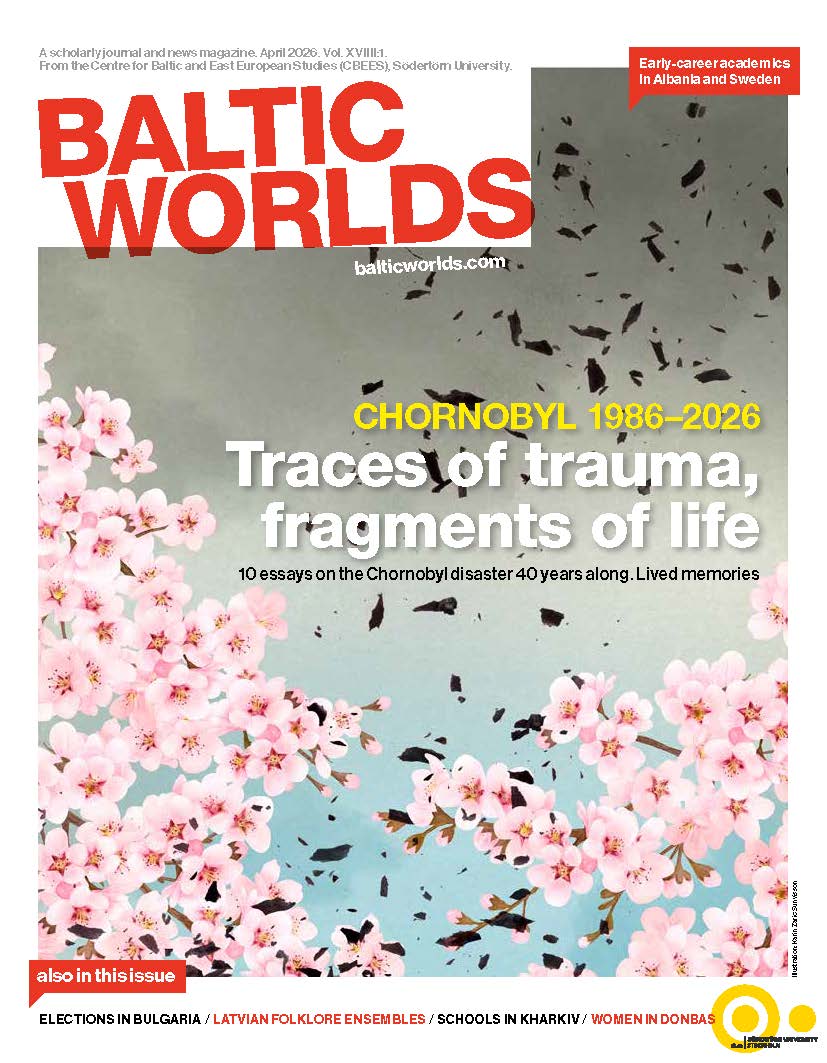 Issue 2026, 1:
 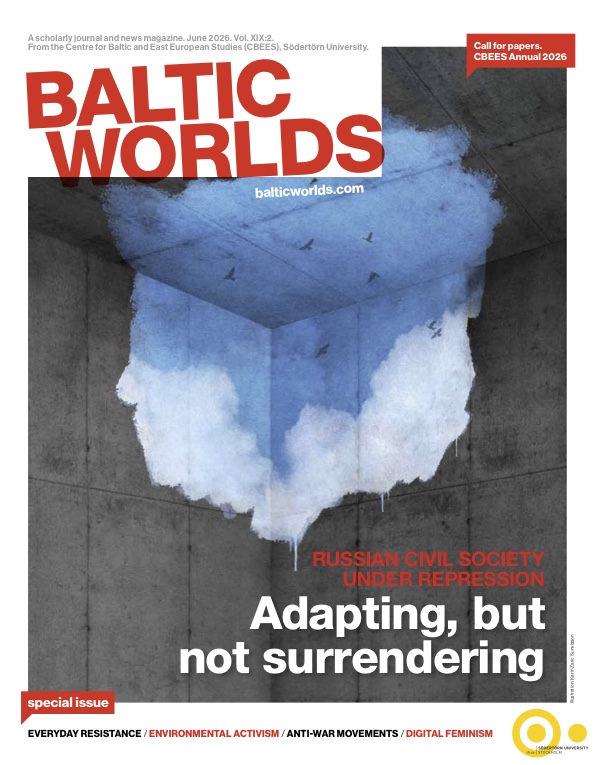 Issue 2026, 2:
  Baltic Worlds covers; the Baltic Sea Region, Eastern Europe, Russia, CentralAsia, Caucasus and the Balkan area.